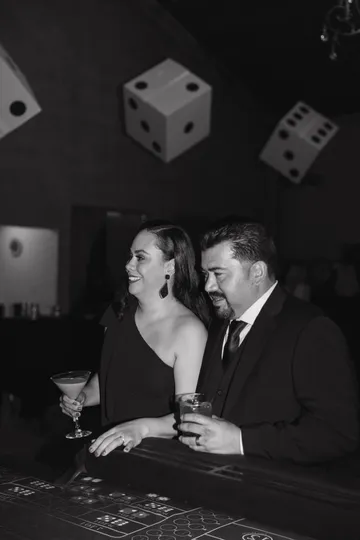
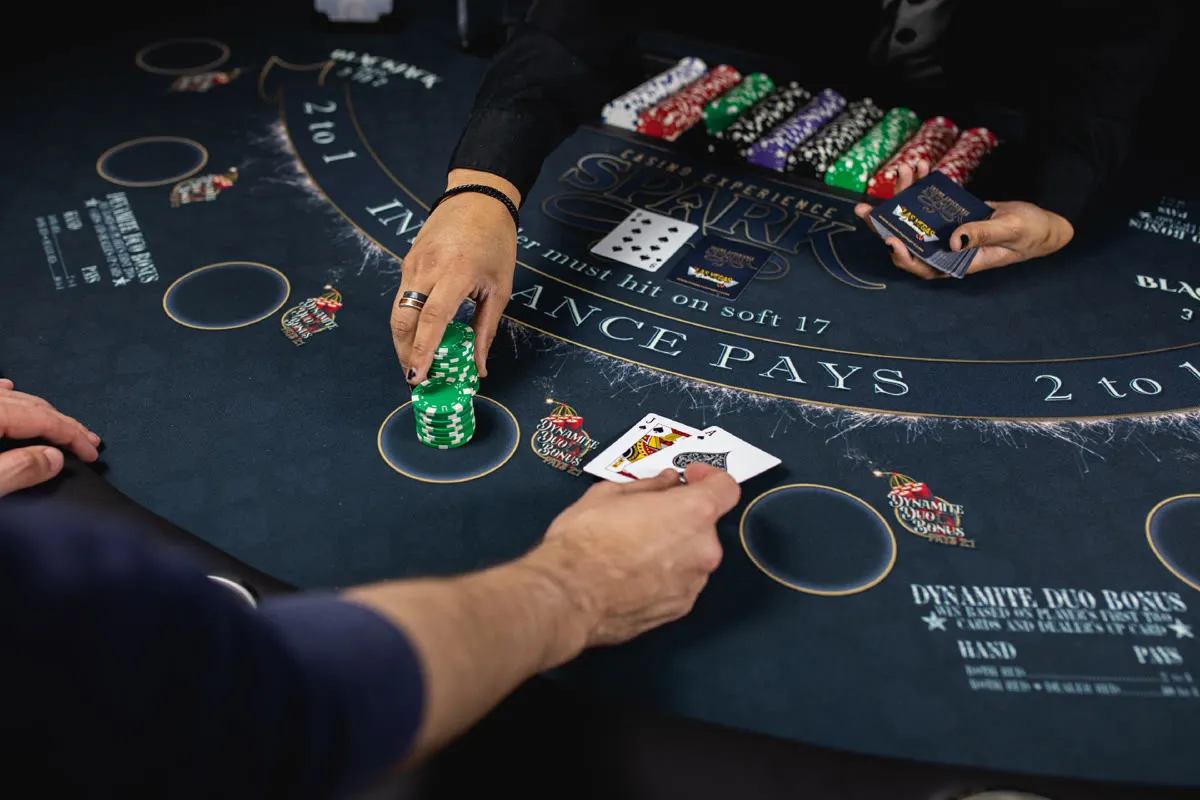
Our dealers run every table exactly like a real casino floor, minus the money on the line: they deal from a real shoe or wheel, explain the rules to first-timers on the first hand or roll, keep the pace moving, and track play-money chips that get counted and collected at the end of the night.
We’ve staffed casino floors at hundreds of private parties across Sacramento, Roseville, Folsom, Elk Grove, and the wineries and barns further out, and the question we hear on almost every quote call is some version of “what does the dealer actually do?” Fair question — most guests have never stood at a real casino table before. Here’s what happens once ours shows up.
What a Spark dealer actually does
A dealer’s job at a private party has three parts running at once: run the game correctly, teach it to anyone who’s never played, and read the table’s energy so it never goes flat. That means shuffling and dealing from a proper shoe on blackjack, calling every roll on craps, spinning and paying out roulette, and running the community-card rounds on Texas Hold’em — all while narrating what’s happening for guests who are learning as they go. Chips get tracked all night so nobody’s arguing over a stack at 10pm, and at the end of the evening the chips are counted and collected.
Table by table: how the pace differs
Every game we deal runs at a different rhythm, which is part of why we mix tables rather than running six of the same game.
| Game | Dealer’s role | Seats per table | Pace |
|---|---|---|---|
| Blackjack | Deals from a shoe, settles each hand against the dealer’s hand | 6-7 seated | Fast — a new hand roughly every 30-45 seconds |
| Craps | Calls the roll, tracks the action across the whole table, keeps energy up | Stand-around, no fixed seats | Fast and loud — the whole table plays every roll together |
| Roulette | Spins the wheel, calls the number, pays out across the layout | Stand-around, no fixed seats | Steady — about a spin a minute, easiest table to walk up to |
| Texas Hold’em | Deals community cards, runs each round of play, manages the tournament clock | 9 seated | Slower and seated — built for a multi-hour tournament arc |
| Three Card Poker / Pai Gow | Deals, compares hands, teaches the split (Pai Gow) or hand ranking | 6-7 seated | Medium — more teaching per hand than blackjack |
That spread is also why we place blackjack and roulette closest to the entrance on most floors — they’re the fastest to pick up cold — and let craps and Hold’em sit a step further in for guests who want more of a challenge once they’re warmed up. We go deeper on that game-by-game breakdown in our beginner’s guide to casino games.
Why a dealer beats a rulebook
You could hand guests a one-page rules sheet at each table and skip the staffing. Nobody reads it. What actually gets a nervous first-timer playing confidently is a person standing across the felt who slows the first hand down, explains it in plain language, and speeds back up once the table’s comfortable — then does that for the next new guest who wanders up ten minutes later. That’s the entire reason a professional dealer, not a rulebook or a friend who “sort of knows blackjack,” comes with every table we send out.
Matching dealer count to your guest list
Table count — and dealer count — scales with your guest list, not the other way around:
- The Ante — up to 25 guests: one table, one dealer
- All In — 30-60 guests: three tables, three dealers (our most-booked package)
- Royal Flush — 60-100 guests: four tables, four dealers
- The High Roller — 100+ guests: seven tables plus a dedicated casino manager coordinating the floor
Full details on games and packages live on our casino party page, and the room-layout math that goes with table count is in our casino night planning checklist. Venue matters too — a barn, winery, ballroom, or backyard each changes load-in logistics more than it changes what the dealers actually do; we cover that in what venues work best for a casino night.
What “entertainment-only” means for the dealer’s job
Every table our dealers run is entertainment-only: guests play for fun with play money, chips carry no cash value, and nothing changes hands. That’s what keeps a private casino night entertainment only, and it’s a rule our dealers enforce as part of running the table, not an afterthought — see our full breakdown of how entertainment-only casino parties work.
Not sure how many tables and dealers your party needs? Get a free quote and tell us your guest count — we’ll build the dealer lineup around it.
Frequently asked questions
What does a casino party dealer actually do at a private event?
Our dealers run the table exactly like a professional floor — dealing from a real shoe or spinning the wheel, calling craps rolls, settling each hand, and teaching first-timers the rules as they play. They also track play-money chips and keep the pace lively so a table never sits idle between hands.
Do casino party dealers teach guests who have never played before?
Yes — teaching first-timers is part of the job, not an extra. Every dealer we send is trained to walk a nervous guest through their first hand or roll before running the game at full speed, and most guests are playing confidently within a few minutes.
How many dealers do I need for my party?
One dealer per table, and table count follows guest count: our Ante package (up to 25 guests) runs one table and one dealer, All In (30-60 guests) runs three tables and three dealers, and Royal Flush (60-100 guests) runs four. Parties over 100 guests also get a dedicated casino manager on top of the dealers.
Do guests ever play for real money at these tables?
No. Every Spark event is entertainment-only — guests play with play money and chips that carry no cash value, and everyone plays for fun. That's true whether the dealer is running a birthday party or a company gala, and it's what keeps casino parties entertainment only.